-
Mail Us: ayaz@riainstitute.in
-
Monday - Sunday: 7:00AM - 8:30PM

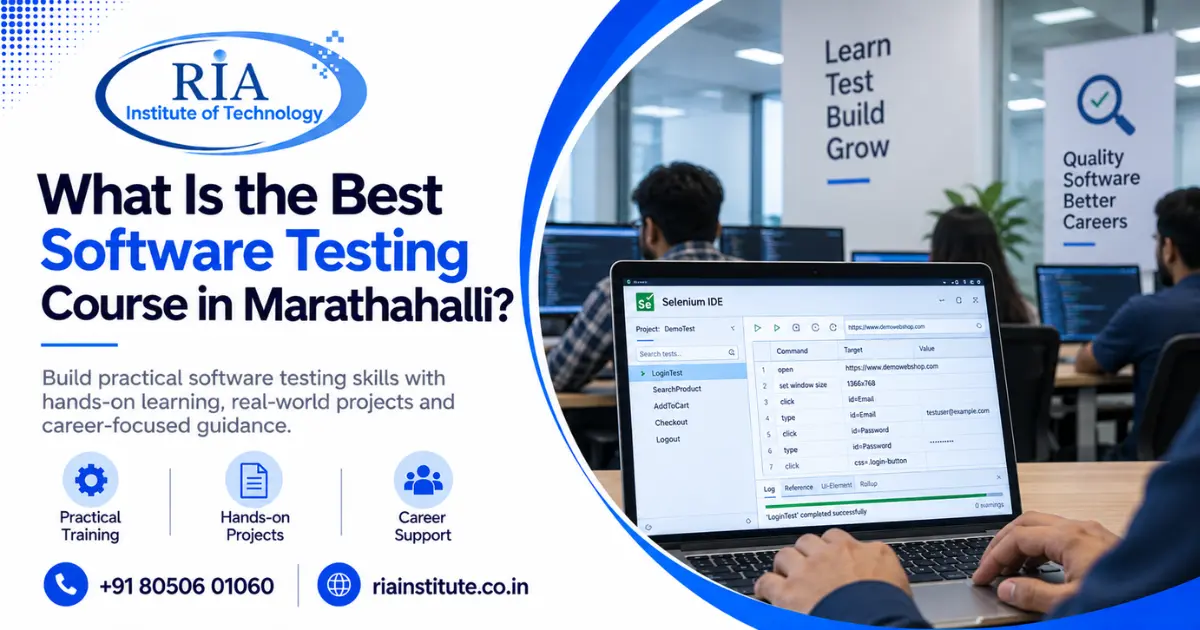
This question is posed on Google each day, and the truth is that this question is much more complex than the mere naming of an institute. The issue of what is "best" is largely determined by your own personal situation and goals. This guide walks through exactly what to look for before you decide.
There is no perfect solution, but the top software testing course in Marathahalli combines manual and automated testing, uses projects and provides placement assistance.
In addition to these minimum requirements, the deciding factor is whether you are a complete fresher, a changed career, or you are currently in the field of QA. A good training program for the fresher can be an easy one for someone with 2 years of experience in manual testing.
Apart from marketing hype, an excellent course possesses certain features. Firstly, it should have modules on manual testing basics as well as one automation tool like Selenium. Second, it must provide practical exercises instead of just slides and theoretical knowledge.
It is also extremely important who will be conducting the course. The teacher with practical experience of working as a QA engineer differs significantly from the instructor reading off the slides. Ask directly about a trainer's real project background before you judge a course by its brochure alone.
Tool coverage also needs to stay current. A course which teaches students nothing but the old way of testing, with no introduction whatsoever to the latest automation frameworks and how to integrate them into CI/CD, will end up creating certain gaps, which you'll find out in your interview. Ask about how often the curriculum is revised.
Another common mistake people make is that they choose a course which deals exclusively with automation and pays little or no attention to manual testing. The basic principles of manual testing, such as test cases and defect reporting, are the foundation for automation testing.
The reverse mistake also happens, where a course stays manual-only and never introduces automation tools. Most Bangalore employers today expect at least basic Selenium exposure, even for primarily manual roles. A genuinely well-rounded course covers both, even if automation ends up getting more depth.
Besides the curriculum, there are some practical questions that you could ask yourself to prevent yourself from making the wrong choice:
Asking such questions at the start takes just a few minutes but could save you months of frustration later on. A good institute will have no problem in answering these questions clearly and promptly. Evasive answers to such questions are often a red flag.
Alongside practical training, it helps to understand where formal Software Certification Courses fit into your testing career. The ISTQB (International Software Testing Qualifications Board) provides certification for software testing which is recognized internationally beginning with the foundation level examination.
The certification does not substitute practical training but does provide an additional qualification sought by many recruiters. A good testing course should at least prepare you for this certification, even if the exam itself is taken separately. Certification alone may not impress interviewers much without any practical skills.
The most powerful combination would be project experience along with a recognized certification. Certification should be treated as an add-on to one’s practical skills rather than being a substitute. For people already working in QA, there are also Advanced Levels offered by ISTQB in various domains such as test management and test analysis.
These make more sense after a few years of real experience rather than right at the start. A beginner course should mention this path exists, without pushing you toward it prematurely.
Ria Institute of Technology runs software testing training from its Marathahalli campus, covering manual testing fundamentals through to Selenium-based automation. Trainers bring real QA project experience into the classroom, not just theoretical teaching. Both classroom and online batches are available, which suits working professionals in the area.
The institute also has a second branch in RT Nagar for those based elsewhere in Bangalore. Comparing the specific syllabus and trainer background here against other options mentioned in this guide is a reasonable next step. And that is the kind of comparison rather than labeling anything the "best" which helps in making the right choice.
Please have a look at your course curriculum and see whether it mentions anything about automation testing. You may also reach out to someone who had done this course before or is taking this course now. A confident institute will make this easy, not difficult.
Yes, software testing is one of the more accessible entry points into IT for non-technical graduates. Manual testing especially doesn't require a programming background to start. Automation testing does eventually require some scripting comfort, which most courses build up gradually.
No, you don’t have to, but it is sure to help make you more competitive on the job market, especially as a beginner with little experience in other projects. There are even firms that prefer hiring candidates with such certification.
Most structured courses covering both manual and automation testing run 2 to 3 months. Rushing through a shorter course often means skipping automation depth. Longer doesn't mean necessarily better; however, shorter programs deserve more attention.
It depends on the experience of the candidate, organization, and the job profile. An entry-level tester is paid lower than an automation one. Real project experience tends to matter more than the course length itself.
Yes, beginner batches are designed to start from fundamentals before introducing automation tools. Trainers assess your starting point before pacing the course. This makes it accessible even without any prior QA exposure.
Classroom training is more suitable for people who wish to have in-person clarification of doubts and accountability. The online mode is perfect for those who wish to take up training along with their job or have a long distance to travel.
There isn’t any one single “best” software testing course that fits everyone perfectly. There will be the best course which suits you according to the three elements mentioned below. These three points hold much more weight than any ranking or review.
Still comparing your options? You can take a free demo class to experience the teaching methodology yourself. You can also post your queries in the comment section below.